
Buy
Spools for tables
Wooden spools for tables, bars and patios: which reel types and flange sizes make a good table top, and how to ask for one around Philadelphia.
What makes a good table reel
A cable reel turned on its side is already most of a table: a round top, a round base and a column between them. Not every reel makes a good one. The things that matter are the flange size, which becomes the tabletop; the traverse, which becomes the table height; the state of the top flange's face; and whether the reel is square, so the top sits level.
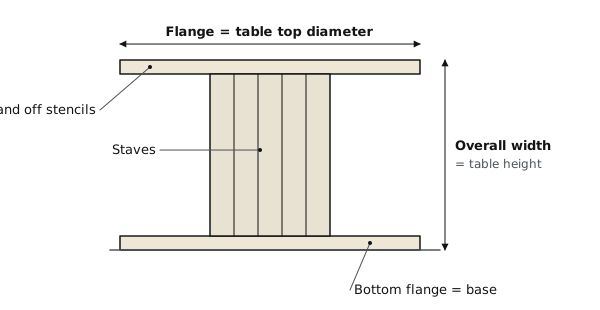
- Height. A reel's overall width (the traverse plus both flange thicknesses) is its height when it stands on a flange. A coffee table wants roughly 16 to 20 inches. A dining or kitchen table wants roughly 28 to 30 inches. Cable makers' tables give the overall width for each reel: Okonite's 24 x 12 x 10 wood reel is 15 inches overall, its 30 x 18 x 12 reel is 22 inches, and Southwire's A-10 nailed reel, 30 x 22 x 16, is 25 inches overall.
- Top size. A 24-inch flange makes a side or coffee table. A 30- to 36-inch flange suits a small dining or café table for two. A 42- to 48-inch flange seats four, and needs a stable floor.
- Face condition. The outer flange is the tabletop. Look for boards without deep splits, without big knots that have fallen out, and without heavy stencilling if you want a plain top. Old labels and light stains sand off.
- Square and flat. A reel that has been dropped can have a flange that is no longer parallel to the other. Ask for reels that stand without rocking.
Plywood or nailed boards?
Plywood reels and spools have flanges cut from a single sheet. They make a flat, smooth top that needs little sanding, but plywood edges chip and the layers can lift if the reel has been wet. Nailed wood reels have flanges built from two layers of boards nailed crosswise. They give a plank-top look, need more sanding and filling, and are tougher. The plywood vs nailed guide covers the differences in detail.
Working the reel into a table
- Pull every nail you do not need. Lagging nails around the rims and any staples from labels come out first.
- Check the drum. Tighten or replace loose staves. A loose stave is the most common reason a reel table wobbles.
- Sand the top. Coarse grit first to take off weathering and stencil paint, then finer. Fill gaps between boards with wood filler or epoxy if you want a smooth surface.
- Seal it. An outdoor table wants an exterior finish; an indoor one wants a hard-wearing clear coat.
- Use the arbor hole. Most wood reels have a 3⅛-inch centre hole, which fits a standard umbrella pole for a patio table, or can be plugged with a dowel.
- Add feet or casters to the bottom flange if the table will move or sit on a floor that should not be scratched.
What to ask for
When you send a buy request for a table reel, say:
- the table height you want (or the overall width);
- the top diameter you want;
- plywood or board top;
- indoor or outdoor use;
- whether plain wood matters (no stencils or labels).
The reply says which reels on hand fit, with their actual measurements, and suggests the closest alternatives if none fit exactly.
Treated wood and indoor use
Cable reels are packaging, built from softwood and plywood. Some reels for export carry a stamp saying the wood was heat treated, which is a heat process, not a chemical one. Occasionally a reel has been treated with a preservative or painted. For indoor tables, and especially anything used for food, ask for plain, unpainted, unstained reels, and seal the wood after sanding.
Delivery in the city
Philadelphia row houses and South Jersey apartments raise a practical point: a 36-inch reel will go through most front doors on its edge, a 42-inch reel often will not, and anything bigger usually lives outside. Measure your doorway before asking for a big reel. Small reels can come with other deliveries in the area; larger ones need a truck and someone to help roll them in.
Casters, tops and finishes
Locking casters make a heavy table movable. Round tempered-glass tops, wooden overlays and resin pours change the look. Finishes range from Danish oil to marine varnish for outdoor use.
Where people put them
Kitchens, cafés, dorm rooms, offices, children's playrooms, porches, rooftop decks and shop windows. For children's rooms, round every edge, check for nails twice, and fix the table so it cannot tip or roll. In cafés, a sealed top resists coffee rings and wipes clean; outdoors, choose oil that can be refreshed each spring rather than varnish that peels.
Wobble fixes
Shim uneven flanges with cedar wedges or adjustable glides.
Questions
Can you cut a reel down to a shorter height?
No. We supply reels as they are. A shorter table is easier to get by choosing a reel with a narrower traverse.
Do you sell finished tables?
No. We supply the reel; the making is yours.
How heavy is a table reel?
Published weights give an idea: Okonite lists 23 pounds for a 24 x 12 x 10 wood reel and 77 pounds for a 36 x 24 x 17 reel, and Southwire lists 66 pounds for its 30 x 22 x 16 nailed reel.
Last reviewed 2026-11-09.