
Guide
Identify your reel
Is it nailed wood, bolted plywood, plastic or steel, and is it yours to sell? Identify any wooden wire reel from its flange, staves, bolts and stencils.
Five things to look at
You can identify almost any empty reel from five observations. Take them in this order, because each one narrows the next.
- What the flanges are made of. Steel, plastic, plywood or boards.
- How big it is. The flange diameter, measured across the widest point.
- What holds it together. Nails only, or tie rods with nuts and washers, or welds.
- What is written on it. Stencils, painted numbers, tags, labels.
- What shape it is in. Flat flanges, tight drum, round arbor hole, sound wood.
Step 1: the flange material
Look at the round side.
- Welded steel, often with spokes or a solid steel disc and sometimes steel tyres around the rim: a steel reel. It almost certainly belongs to the cable maker.
- Moulded plastic with ribs running out from the centre: a plastic reel or spool.
- A single sheet of plywood, showing layered edges: a plywood reel or spool.
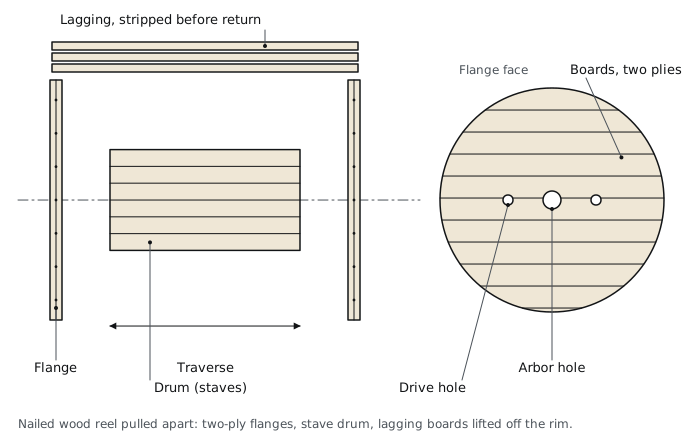
- Boards in two layers, one running across the other, with rows of nail heads: a wooden reel, either nailed or bolted.
Step 2: the size
Measure the flange from edge to edge through the centre. Under about 24 inches, the reel is a small wooden spool or a small plastic spool. From 48 inches up, it is a large wooden spool, and from about 60 inches up it may be bolted or steel. The measuring guide covers traverse, drum and arbor hole too.
Step 3: the fastenings
Look at the outer face of the flange and around the centre.
- Nail heads only: a nailed reel.
- Large nuts and washers in a ring, with threaded rod ends: tie rods, so a bolted reel.
- A steel plate over the centre hole, bolted through the wood: an arbor plate, common on heavy wooden reels.
- Welds: steel.
Look between the flanges as well. Extra flanges partway along the drum mean a compartment reel. A slot or hole cut into one flange near the drum often means a fiber optic reel, where the inner cable end was brought out for testing.
Step 4: the writing
This is the step that decides ownership. Check both flange faces and the area around the arbor hole.
- A maker's name stencilled in large letters, with RETURNABLE, RETURN TO or PROPERTY OF: a returnable reel.
- A painted or stamped serial number, or a metal plate with a number: probably tracked by its maker; treat as returnable until checked.
- A deposit tag or return instructions: returnable.
- Only a paper shipping label with the cable description: almost always one-way.
- Southwire's codes such as NR 30.22 or A-38 painted on the flange: look the reel up in the size tables for its full dimensions.
Southwire, for example, ships its wooden reels as non-returnable with no deposit and its steel reels as returnable with charges.
Step 5: the condition
Finally, decide whether the reel can be used again.
- Stand it on each rim: does it sit square?
- Roll it a few feet: does it wobble or click?
- Look into the arbor hole: is it round and free of cracks?
- Count the drum staves: are any missing or loose?
- Push a screwdriver into the bottom rim: is the wood firm?
Pass all of these and the reel is reusable. Fail one and it is probably recycling. See broken reels.
Putting it together
A plain board-flanged reel, 42 inches across, nails only, a paper label, flat and tight: a one-way nailed wood reel that sells. A steel reel, 84 inches across, with a painted number: a returnable steel reel to go back to its maker. A 15¾-inch plywood spool with a peeling flange: a plywood spool for recycling. Send your observations with the request form and we will confirm the entry.
Clues from where the reel was found
The place a reel turned up is a useful hint. Reels in a house basement or a small shop are usually small spools from building wire or low-voltage cable, nearly always one-way. Reels behind a commercial building after a fit-out are typically mid-size nailed reels from feeders. Reels in a utility yard, by a substation or at the edge of a road dig are often large, and more likely to be steel or stencilled. Reels by a telephone pole line or a fibre cabinet are probably fiber optic reels. Reels at a marine terminal or industrial plant may be heavy bolted reels. None of these is proof, but each one tells you which entries to check first.
Common mix-ups
- Plywood or boards? Some reels have plywood flanges with boards nailed across them for strength. Count them as plywood if the main disc is a single sheet.
- Bolted or nailed with through-bolts? Many nailed reels have two or four long bolts through the drum. A bolted reel has a full ring of tie rods and usually an arbor plate.
- Steel or steel-reinforced? An arbor plate or a steel band around a wooden rim does not make a steel reel. Welded steel flanges do.
- Returnable or just labelled? A cable maker's printed shipping label is not a return mark. A stencil, painted number or tag is.
Words you will see on reels
Shipping labels and stencils use short codes. You might see the cable type (THHN, XHHW, MV-105), the conductor size, the length in feet, a reel or drum number, the gross and tare weight, and the maker's plant. Gross weight minus tare gives the cable weight that was on it; tare alone is the empty reel's weight, which is handy for planning a pickup.
Unusual finds
Old porcelain-insulator crates, cardboard tubes, wire baskets and hose carts are sometimes mistaken for reels.
Hybrid builds
Some reels mix materials: plywood flanges on a cardboard core, steel arbor plates on timber, or plastic hubs inside wooden rims. Classify those by whatever bears the load, usually the flange, and mention the oddity separately. Hybrids confuse sorting crews, so a quick note avoids surprises.
Questions
What if there is no writing at all?
A wooden or plywood reel with no markings is almost always one-way and yours to sell or recycle.
Do I need to know the cable maker?
Only if the reel might be returnable. For one-way reels, the maker does not change anything.
Can you identify a reel from a photo?
Usually. Send one photo of a flange face and one from the side.
Last reviewed 2026-11-09.