
Guide
How to measure a cable reel
Measure a cable reel in three numbers: flange diameter edge to edge, traverse between the flanges, and the arbor hole. Then find its row in the catalogue.
Four measurements and a count
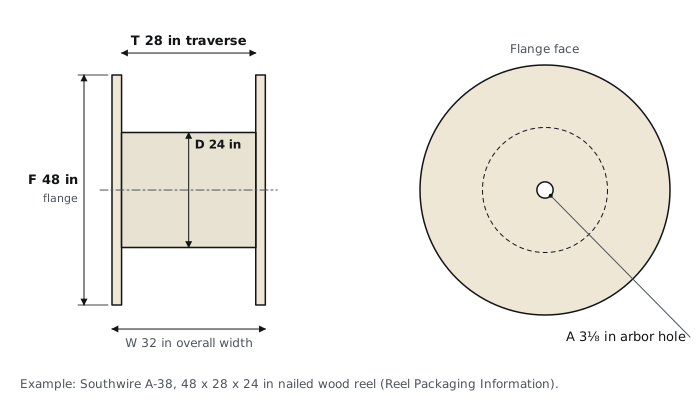
A cable reel is described by four numbers: flange diameter, traverse, drum diameter and arbor hole. Cable makers write the first three in a fixed order. Okonite's Technical News on reel anatomy gives it as Flange x Inside Traverse x Drum, all in inches, following the NEMA WC 26 packaging standard, so a 42 x 28 x 21 reel has a 42-inch flange, 28 inches between the flanges and a 21-inch drum. The arbor hole is measured separately. Add a count, and a reel list is complete.
What you need
- A tape measure at least as long as the reel is wide. A 25-foot builder's tape is ideal.
- A phone camera.
- For big reels, a second person to hold the tape end.
- Gloves; reels have nails and splinters.
1. Flange diameter
Measure across the round side of the reel, from one edge to the opposite edge, through the centre. On a reel standing on its rim, run the tape across the bottom of the flange where it meets the ground, or across the face at the height of the arbor hole. Round to the nearest inch. This number puts the reel in its size class in the size tables: a reel that measures 41 or 43 inches is a 42-inch reel.
2. Traverse
The traverse is the inside width between the two flanges, measured at the drum. It is the space the cable occupied. Put the tape between the inner faces of the flanges, close to the drum, and read the gap. On reels where the flanges bow slightly, measure at the drum, not at the rim.
3. Drum diameter
The drum is the core between the flanges. On an empty reel, measure across it from side to side, or measure its circumference with a flexible tape and divide by 3.14. On a reel that still has cable on it, the drum is hidden; estimate it from the arbor hole area or leave it out.
4. Arbor hole
The arbor hole is the hole through the centre, where the shaft of a reel stand goes. Measure across it. Wooden reels from most North American cable makers have a hole of 3⅛ inches; Southwire lists 3.125 inches for its wood reels and 2 inches for its small G series plywood spools. Steel reels have larger bushings, from 3 inches up to 7⅝ inches on Southwire's list. If there is a steel plate bolted over the hole, note that; it is an arbor plate.
5. Overall width
Measure from the outside face of one flange to the outside face of the other. This is the traverse plus both flange thicknesses, and it is the reel's height when it stands on a flange, which matters for tables, doorways and truck space.
What to photograph
If you cannot get a tape on the reel, two or three photographs do almost as well:
- A straight-on shot of one flange face, with something of known size in frame (a tape measure laid across it, a standard door, a person).
- A side-on shot showing both flanges and the drum.
- A close-up of any writing, stencil, tag or label.
Worked example
A reel in a yard in Bensalem: flange 48 inches, traverse 28 inches, drum 24 inches, arbor hole 3⅛ inches, overall width 32 inches, nails only, paper label. That matches Southwire's published A-38 nailed wood reel at 48 x 28 x 24 inches and 32 inches overall. It is a one-way 48-inch nailed reel, and its row in the catalogue says it sells when sound.
Mistakes to avoid
- Measuring the flange across a chipped edge or a missing board gives a short reading. Measure across the best diameter.
- Measuring the traverse at the rim instead of at the drum gives a wider reading on bowed flanges.
- Measuring overall width and calling it traverse adds the flange thickness twice.
- Rounding the arbor hole to 3 inches when it is 3⅛ matters for reel stands; measure to the eighth if you can.
Recording a whole yard
For more than a handful of reels, a simple table saves time. Walk the yard once with a notebook or a phone spreadsheet and record, for each group of matching reels: flange, traverse, build (nailed, plywood, bolted, steel, plastic), markings, condition, and count. Group by flange first. A yard of eighty reels usually boils down to six or eight lines. Mark each counted reel with a dab of spray paint or chalk on the flange so nothing is counted twice, and keep a separate line for reels with stencils or tags. That table, pasted into the message box of the request form, is the best reel list we receive.
Metric reels
Most reels in this market come from North American mills and are sized in inches, but imported cable sometimes arrives on reels sized in millimetres or centimetres, often stencilled with a European drum designation. Convert by dividing millimetres by 25.4: a 1,000 mm flange is about 39 inches, a 1,250 mm flange about 49 inches, and a 1,600 mm flange about 63 inches. Note on the list that the reel is metric, and measure its arbor hole rather than assuming the usual 3⅛ inches.
Reels with cable still on
If cable remains on the reel, measure the flange and the overall width as normal, and estimate how much cable is left by measuring the gap between the outer layer of cable and the flange rim. Mention it in the request. Partly full reels are not empties; the cable belongs to whoever bought it.
Tools beyond the tape
A folding rule, a straightedge laid across both flanges, and a smartphone photo with a coloured tape in shot speed things up.
Recording in a spreadsheet
Columns for tag number, flange, traverse, drum, arbor, width, build, markings and condition make a yard inventory sortable and easy to email.
Gloves and ladders
Wear gloves against splinters; never climb onto tall flanges.
Questions
Do I need all four measurements for a pickup request?
No. The flange diameter and a count are enough to start. The rest helps buyers and rewinders.
My reel is too big to measure alone. What then?
Pace it out: a typical adult stride is about 30 inches. Or photograph it next to a door, which is about 80 inches tall.
Why measure in inches?
Because the cable makers who publish reel tables for North America do, and the size tables on this site match theirs.
Last reviewed 2026-11-09.