
Guide
Plywood spools vs nailed wood reels
Plywood spools and nailed wood reels compared: how each is built, how each wears, which reuse and which recycle, and which suits a table or re-spooling.
Two ways to build a reel
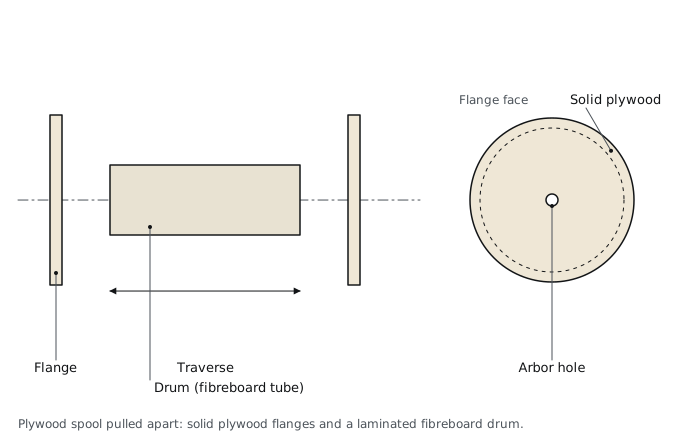
Wooden cable reels are built in two main ways. A plywood reel or spool has flanges cut as discs from plywood sheet: one piece per flange, with the layered edge showing around the rim. A nailed wood reel has flanges built up from boards: one layer of boards laid side by side, a second layer laid across them at a right angle, and the two nailed together. Southwire's reel information describes its all-wood reel flanges as two-ply, nailed at 90 degrees, and its plywood reels as having either fibreboard tube drums or stave drums. The drum, the arbor hole and the overall shape are similar; the flange is what differs, and it changes how the reel behaves.
Size ranges
Plywood is used mainly for small and mid-size reels, roughly 12 to 30 inches across. Southwire's G series spools (11¾ to 15¾ inches) and N series plywood reels (15¾ to 23¾ inches) and Prysmian's 29½-inch plywood reel are typical. Nailed boards take over above that and run up to the largest wooden reels. In the 18- to 30-inch range, both builds are common and the choice is the cable mill's.
Side by side
| Plywood | Nailed boards | |
|---|---|---|
| Flange | One disc cut from sheet | Two layers of boards, crossed |
| Drum | Fibreboard tube or staves | Wooden staves |
| Arbor hole | 2 in on small spools, 3⅛ in on reels | Usually 3⅛ in |
| Weight | Lighter for its size | Heavier |
| Surface | Smooth, flat, few gaps | Plank faces with gaps and nail heads |
| Edges | Layered, chip if knocked | End grain, tougher |
| Water | Layers lift and peel when soaked | Boards swell and split, but slower |
| Repair | Hard: a damaged disc is replaced whole | Easy: a single board can be replaced |
| Typical use after | Tables, stools, light hose and wire | Rewinding cable, outdoor tables, heavy use |
For carrying cable again
Contractors and rewinders who want reels for cable prefer nailed reels for anything heavy. Boards take impacts, a broken board can be replaced, and a stave drum holds more weight than a fibreboard tube. Plywood reels are fine for building wire, communication cable and other light products, and they are what most small reels are made of anyway. The deciding checks for both are the same: flat flanges, a tight drum, a round arbor hole.
For furniture
Makers usually prefer plywood for indoor pieces. The top is already flat and smooth, so a light sanding and a clear coat give a finished surface. A nailed reel needs nails pulled, gaps filled and the surface sanded much harder, but it gives a rustic plank look that some people want, and it survives outdoors better. See choosing a spool for a table.
For outdoors and gardens
Neither build is made to live outside, but nailed boards cope better. Plywood that sits in the rain delaminates: water gets into the edge, the glue between the layers fails and the outer veneer peels away. Nailed boards swell, shrink and eventually split, but over a longer time. For a hose reel or a garden table that will stay outside, a nailed reel lasts longer, especially if it is sealed and stood off the ground.
For recycling
Both builds recycle the same way: the wood is separated from the metal and chipped or recovered. Plywood contains glue, which some mulch producers avoid, so plywood is more often chipped for fuel than for landscaping. Nailed boards are cleaner timber. Fibreboard tubes from plywood spools go with paper waste when dry.
How to tell them apart in a pile
Look at the rim. A layered edge, like the side of a stack of paper, is plywood. Individual board ends, with a second layer showing at right angles behind them, is nailed. Look at the face: rows of nail heads across separate boards mean a nailed reel; a smooth surface with a few nails near the drum means plywood. Look at the drum: a brown cardboard-like tube means a plywood spool.
Cost to the cable maker
Plywood reels are cut by machine from sheet stock in large numbers, which keeps them cheap and uniform for small, light cable. Nailed timber reels use sawn boards, battens and staves, and scale up more easily to heavy loads and large diameters. Makers pick whichever build carries their product safely at the lowest cost. Neither one is "better" in general; each is suited to its job, and both have second lives.
Smell, colour and grain
Fresh plywood smells of glue and shows thin layered edges; sawn timber smells resinous, with visible knots, growth rings and saw marks. After years outdoors, both turn silver-grey, but plywood edges fray into layers while timber edges check and split along the grain.
Indoor air and finishes
Some plywood glues contain formaldehyde-based resins; airing new sheets outdoors and sealing them reduces odour indoors.
Workshop behaviour
Plywood cuts cleanly with fine-toothed blades and rarely splits near screws, so it suits shelves, signs and toys. Sawn boards from nailed reels hide buried nails that ruin blades; sweep them with a metal detector before cutting, then plane or joint the faces for reclaimed-lumber projects.
Questions
Which is better value to buy?
For a small table or stool, plywood. For anything outdoors or carrying weight, nailed.
Are plywood reels ever returnable?
Rarely. Small plywood spools are almost always one-way. Check for a stencil or tag anyway.
Can a peeling plywood flange be saved?
Small lifts can be glued and clamped. A flange that is peeling across its face is finished.
Last reviewed 2026-11-09.