The smallest class in the catalogue
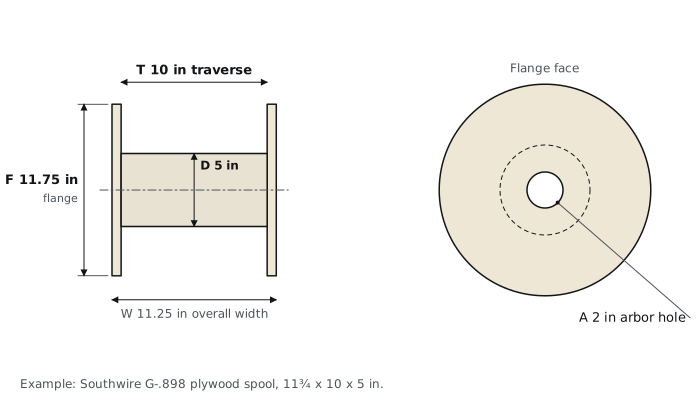
The 12-inch class covers spools from just under 12 inches to about 14 inches across. These are the spools that ship small building wire, control wire, thermostat cable and similar products that an electrician carries into a house in one hand. Southwire's G-.898 plywood spool is the classic example at 11¾ inches across, with a 10-inch traverse, a 5-inch drum and a 2-inch arbor hole, weighing about 2¾ pounds empty. Its G-1.235 is slightly bigger at 13½ inches across and 3 pounds. Okonite lists a 14 x 10 x 5 wood reel at 5 pounds. The table above gives each one with its source.
How to recognise a 12-inch spool
Hold a tape across the flange: anything from about 11½ to 14 inches belongs here. Most are plywood, with flanges cut from a single sheet and a fibreboard tube in the middle that looks like heavy cardboard. The arbor hole is small, often 2 inches rather than the 3⅛ inches of bigger wood reels, which matters if you plan to put the spool on a stand or a pipe. A few are tiny nailed reels with plank flanges, and some are plastic. The overall width is usually about 11 inches, so the spool is roughly as wide as it is tall.
Where they pile up
Small spools collect in electrical contractors' vans and shops, in the back rooms of hardware stores, in maintenance departments at schools and hospitals, and in the garages of anyone who has rewired a house. In Philadelphia's row-house neighbourhoods they often turn up after a renovation, stacked by the back door. They are light, so they are easy to ignore until there are dozens.
Selling or clearing them
One 12-inch spool is not worth a truck trip. A box of them is. If you have a stack, count them, check that the flanges are not peeling and the tubes are not crushed, and send the count with your ZIP code. Small spools ride along with other pickups in the area, so they are collected when a truck is nearby rather than on a set day. Spools with crushed tubes or delaminating plywood go to recycling: the plywood is chipped with other clean wood and the fibreboard goes with paper waste if it is dry.
Uses after the wire is gone
The 12-inch spool is the size crafters, teachers and gardeners ask for most:
- winding polywire or polytape for temporary electric fencing;
- small hose, drip line and twine;
- extension cords and string lights in a workshop;
- classroom and art projects;
- small plant stands and shelf risers.
The 2-inch arbor hole fits a short length of 1½-inch pipe as an axle, which makes a simple hand reel.
Handling and storage
Stack 12-inch spools flat or on edge in a dry place. Do not leave them on the ground outside; plywood soaks up water at the rim and the layers separate within weeks. A milk crate or a cardboard box holds several, which also makes them easy to count and load.
Counting by the box
Nobody counts 12-inch spools one by one in a request. A rough count works: "about two milk crates", "a shelf full, maybe forty". What matters more is the mix. Say how many are plywood, how many are plastic and how many are small nailed spools, because each goes a different way. Plywood ones in good shape are resold, plastic ones are recycled, and the occasional tiny nailed spool goes either way depending on the wood. If the spools still have short ends of wire on them, mention it; leftover copper is easy to strip off and has scrap value of its own that belongs to you.
Arbor holes and bars
The 2-inch arbor hole on Southwire's G spools is a practical detail for anyone reusing them. A 1½-inch steel pipe slides through with room to spin, a broom handle works for light twine, and a threaded rod with washers turns one into a wall-mounted dispenser. Spools with larger holes need a bigger bar, so check before buying a rack for them.
Small spools in craft rooms and classrooms
Twelve-inch spools have a long second life away from the trades. Teachers use them as stools for reading corners, stands for science projects and bases for model volcanoes. Crafters wind ribbon, twine, garden string and fairy lights on them, or stack a few into a plant stand. Woodworkers cut the flanges into coasters, trivets and clock faces, and the drums into candle holders. None of that needs a sound arbor hole or perfect flanges, which is why even scuffed small spools rarely go to waste. If you need a box of them for a school or club, mention it in a request; we often have more small spools than buyers.
Plastic lookalikes
Many 12-inch spools are injection-moulded plastic, black, grey or orange, from wire makers. They look similar in photos but are recycled with plastics, not wood. Separate them before a pickup.
Questions
Is a 12-inch spool the same as a plastic wire spool?
Same size class, different material. Plastic spools of this size are mostly recycled; see plastic reels and spools.
Do you buy single small spools?
Not usually one at a time. In a box of a dozen or more, yes.
Last reviewed 2026-11-09.