
Entry 06
- Flange
- Any
- Traverse
- Any
- Arbor hole
- Any
- Build
- Steel, or wood stencilled with a maker's name
- Ownership
- Belongs to the cable maker
- Verdict
- Returnable
Catalogue entry 06
Returnable cable reels belong to the cable maker: the stencils, tags and serial numbers that mark them, how deposits and credits work and how we route them back.
Entry 06
This entry is about ownership, not construction. A returnable reel can be steel or wood, small or large. What makes it returnable is that the cable maker, or sometimes the distributor, expects it back, and either charged a deposit for it or will charge if it does not come back. Because of that, the person holding an empty returnable reel cannot sell it. The right thing to do is return it, and the holder or the original cable buyer usually gets a credit for doing so.
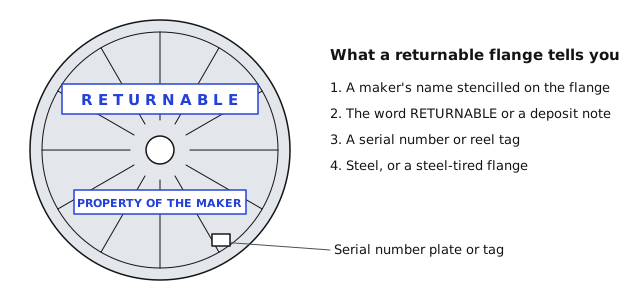
Look at both flange faces and around the arbor hole. Any one of these is a strong sign:
A plain wooden reel with only a paper shipping label is almost always one-way. Southwire, for instance, ships its wooden reels as non-returnable with no deposit.
Reels cost money to build, and large or steel ones a lot of money. A maker that gets its reels back can fill them again. Return programmes also reduce the timber and steel each shipment uses. Some makers run take-back schemes for their wooden reels as well: Service Wire's reel return takes back its own-label nailed wood reels between 30 and 72 inches in full truckloads, provided at least 75 percent of the staves are intact, the reel has no rot and the arbor hole is undamaged. Sonoco, which makes reels for cable companies, runs EcoReel, a free truckload pickup of viable used wood and polyfiber reels for contractors, utilities and distributors across most of the United States.
When a reel list includes returnables, we:
We do not buy returnable reels, and we do not take them to "return on your behalf" without the owner's arrangement, because the credit belongs to whoever paid the deposit.
Usually the company that bought the cable. On a construction project that might be the electrical contractor, not the building owner or the general contractor. If you find returnable reels after a project has ended, contact the contractor that installed the cable first; they may already have a return arranged.
Return programmes often want a full truckload, one brand at a time. A contractor with three returnable reels from one maker and two from another may simply leave them in a corner until there are enough to call in. Over time those reels get buried in mixed piles. Sorting them out at the start of any clear-out is the single most useful step, and the one that keeps credits from being lost.
Two or three photographs settle most ownership questions without anyone driving out. Take one straight-on picture of each flange face, so any stencil or painted number can be read. Take a close-up of anything fixed near the arbor hole: a metal plate, a plastic tag, a paper label with a barcode. If there is a shipping label on the drum, photograph that too, because it often names the cable maker and the buyer. Send the pictures by email with your request. If several reels are the same, one set of photos with a count is enough.
Makers handle returnable reels in different ways. Some charge a deposit when the cable is sold and refund it when the reel comes back. Some add a reel charge to the invoice and credit it on return within a time limit; Southwire's steel reel terms, for instance, credit reels returned within 12 months. Some simply expect the reel back and bill for it if it does not come. In every case the money sits with the company that bought the cable, which is why the right first call is usually to the contractor or distributor, not to the maker directly.
Utility contractors' laydown yards in Delaware County and along the river in Gloucester County, distributor yards in Montgomery County, and the big construction sites in Bucks County and South Philadelphia are where returnable reels collect in this market. They usually sit beside one-way reels of the same size, which is exactly why each one should be checked.
Some reel owners now fit barcodes, RFID tags or even GPS trackers to their reels, so they can locate them across job sites. A reel with a tracker attached is almost certainly returnable. Leave the tag in place.
Some cable makers use pooled or managed reel programmes: they own a fleet, lend reels to cable makers, track them through distributors and contractors, and collect them afterwards. Pool reels usually carry the pool operator's name, a serial, and instructions for return, sometimes with a toll-free number or website. Follow those instructions, or tell us and we will hold the reel for its owner.
Reels abandoned for years on vacant lots still belong to someone; owners usually welcome a call or email.
No. The reel belongs to the maker whether or not the stencil is visible.
Keep a record of who you contacted and when. Makers generally do collect; if one cannot be reached, ask the distributor that sold the cable.
Some are. Look for a deposit or return statement moulded or printed on the flange.
Last reviewed 2026-11-09.
Request
Say whether you want to sell, recycle or buy, the reel type, a rough flange size, the count and the ZIP code. That is enough to start.
We reply about which reels sell, which are recycling only and which are returnable, and agree a day and a loading plan.
Or email the list, with a photo of a flange face, to info@phillywoodenspools.com.