
Cable reel sizes, by flange
Cable reel sizes from 12-inch spools to 96-inch reels: flange, traverse, drum and arbor hole for each size, and what each size is used for around Philadelphia.
36-inch flange reels
- Traverse
- 16.38–28 in
- Drum
- 12–20 in
- Arbor holes
- 3⅛ in
- Per truck (Sonoco)
- 200 (36 x 24 x 17)
One person rolls it, two lift it
42-inch flange reels
- Traverse
- 24–29 in
- Drum
- 17–24 in
- Arbor holes
- 3⅛ in
- Per truck (Sonoco)
- 120 (42 x 26 x 18)
Two people or a forklift
48-inch flange reels
- Traverse
- 22–32 in
- Drum
- 24 in
- Arbor holes
- 3⅛ in
- Per truck (Sonoco)
- 100 (48 x 28 x 24)
Forklift or two people rolling
54-inch flange reels
- Traverse
- 30–32 in
- Drum
- 21–26 in
- Arbor holes
- 3⅛ in
- Per truck (Sonoco)
- 60 (54 x 32 x 36)
Forklift
60-inch flange reels
- Traverse
- 28–40 in
- Drum
- 28–32 in
- Arbor holes
- 3⅛ in, 3 in
- Per truck (Sonoco)
- 39 (60 x 28 x 28)
Forklift
66-inch flange reels
- Traverse
- 28–36 in
- Drum
- 30–36 in
- Arbor holes
- 3⅛ in, 3 in
- Per truck (Sonoco)
- 24 (66 x 36 x 36)
Forklift
72-inch flange reels
- Traverse
- 36–48 in
- Drum
- 36 in
- Arbor holes
- 3⅛ in
- Per truck (Sonoco)
- 22 (72 x 36 x 36)
Forklift
84-inch flange reels
- Traverse
- 36–54 in
- Drum
- 42–48 in
- Arbor holes
- 5¼ in
- Per truck (Sonoco)
- 9 (84 x 46 x 42)
Forklift with long forks, or a reel trailer
96-inch flange reels
- Traverse
- 48–60 in
- Drum
- 42–56 in
- Arbor holes
- 5¼ in
- Per truck (Sonoco)
- 8 (96 x 60 x 42)
Forklift rated for the weight, or a crane
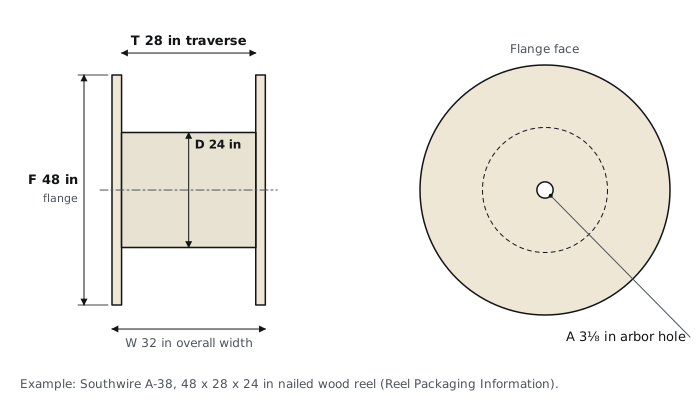
How reel sizes are written
A reel's size is three numbers in inches: flange diameter, inside traverse and drum diameter, in that order. Okonite's Technical News on reel anatomy writes it as Flange x Inside Traverse x Drum, for example 96 x 48 x 56, and notes that the packaging standard behind those designations is NEMA WC 26 in the United States and EEMAC 201 in Canada. Cable makers also give an overall width (the traverse plus both flange thicknesses) and an empty weight. When you send a size, the flange alone gets you into the right row of the table above; the traverse and drum narrow it to a specific reel.
Cable mills often give their reels catalogue codes as well. Southwire, for instance, uses letter series: A and C codes for its nailed wood reels, N for nailed and plywood reels, G for small plywood spools and S for steel reels. A code stencilled on the flange is the fastest way to identify a reel, because the maker's table gives every dimension for it.
Measuring your own reel
- Flange. Measure straight across the round side through the centre, edge to edge. Round to the nearest inch.
- Traverse. Measure the inside gap between the two flanges, at the drum.
- Drum. Measure across the core if you can see it, or estimate from the height of the wound cable if the reel is not empty.
- Arbor hole. Measure the centre hole. Most wood reels are 3⅛ inches; anything larger usually has a steel arbor plate.
The measuring guide has a worked example and a list of what to photograph if you cannot get a tape on the reel.
How size changes the pickup
Small spools up to about 24 inches are carried by hand and stacked in a pickup bed or van. The 30- to 42-inch class can be rolled by one person on level ground but needs two to lift. From 48 inches up a reel needs a forklift or a reel trailer, and from 84 inches up the forklift has to be rated for reels weighing well over half a ton. Sonoco's EcoReel programme publishes how many reels of each size fit in one of its trucks, from 200 reels of 36 x 24 x 17 down to eight reels of 96 x 60 x 42, and those counts are a fair guide to how many reels make a truckload anywhere.
| Size class | Reel listed | Reels per truck |
|---|---|---|
| 36-inch | 36 x 24 x 17 | 200 |
| 42-inch | 42 x 26 x 18 | 120 |
| 48-inch | 48 x 28 x 24 | 100 |
| 54-inch | 54 x 32 x 36 | 60 |
| 60-inch | 60 x 28 x 28 | 39 |
| 66-inch | 66 x 36 x 36 | 24 |
| 72-inch | 72 x 36 x 36 | 22 |
| 84-inch | 84 x 46 x 42 | 9 |
| 96-inch | 96 x 60 x 42 | 8 |
Which sizes people want
Buyers ask for two ends of the table. Small plywood and nailed spools, 12 to 30 inches, go to workshops, growers and anyone who winds hose, rope or fence wire. Mid-size nailed reels, 36 to 48 inches, are the most reused size class on job sites and the most requested for tables. Reels from 60 inches up rarely sell one at a time; they move in truckloads to companies that rewind cable or recover the timber.
Reading a reel's label
Reels often carry a printed or stencilled label giving the maker, the reel type or number, sometimes the dimensions, and sometimes a tare weight. Cable labels stapled to the flange show what was on the reel: conductor size, insulation, voltage rating and length. When the cable is gone, the reel label still helps identify the size class quickly. Photograph it before tearing it off.
Sizes by trade
Electricians wiring houses and offices go through 12- to 30-inch spools and reels. Commercial and industrial feeders use 36- to 54-inch reels. Utilities and big campuses use 60 inches and up. Fibre crews favour wide-traverse plywood reels in the 36- to 60-inch range. Each trade's yard therefore leans toward a few classes, which helps us plan the truck.
When a size is ambiguous
If your measurement falls between two classes, list both. Two inches either way changes nothing about how a reel is moved or reused, and we will confirm on arrival.
Common designations decoded
A label like 48 x 30 x 24 gives flange, traverse and drum in inches; some makers add the arbor hole or overall width. Nailed, bolted, plywood and steel builds can share identical dimensions, so construction is noted separately.
Metric reels
Imported cable sometimes arrives on reels labelled in millimetres. Divide by 25.4 to convert, then round to the nearest class.
Classes and why they are grouped
The table groups flanges within a few inches of each other into one class, named after the round number at its centre. A 23¾-inch plywood reel and a 25-inch nailed reel both sit in the 24-inch class, because they handle the same way, fit the same truck space and suit the same buyers. Each class page lists the actual published dimensions, so nothing is lost by grouping.
Last reviewed 2026-11-09.