The forklift line
Forty-eight inches is where reels cross from "two people can manage" to "bring a forklift". A 48-inch reel stands about four feet tall on its rim and weighs from roughly 140 to 250 pounds empty. It carries the heavier feeders on large commercial and industrial buildings, medium-voltage cable for building substations, and a lot of utility distribution cable. It is also the size most often seen in a distributor's yard, because it is big enough that customers send it back rather than dispose of it.
Published examples
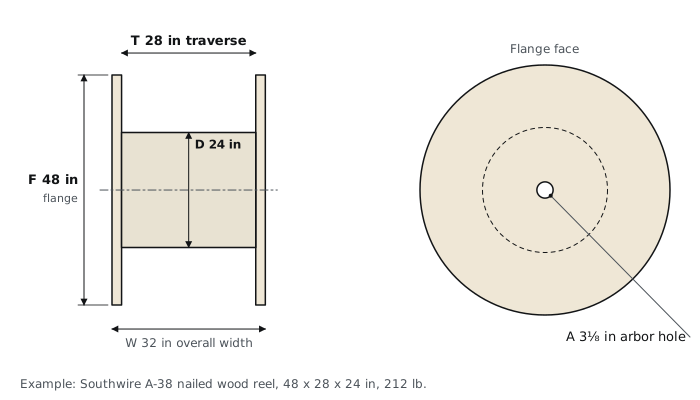
- Southwire A-38 nailed reel, designated NR 48.28: 48 x 28 x 24 inches, 32 inches overall, 3⅛-inch arbor hole, 212 pounds.
- Southwire C-29 nailed reel: 46 x 24 x 24 inches, 30 inches overall, 250 pounds.
- Prysmian 48-inch wood reel: 48 x 22 x 24 inches, 26 inches overall, 178 pounds.
- Okonite 50 x 32 x 24 wood reel: 36½ inches overall, 143 pounds.
Sonoco's EcoReel truck table lists up to 100 reels of 48 x 28 x 24 per truck, half the count for 36-inch reels.
Moving a 48-inch reel
With a forklift, the forks go under the drum between the flanges, spread as wide as the traverse allows, and the reel is lifted just clear of the ground. Never push the forks through the flange boards. Without a forklift, two people can roll a 48-inch reel on hard, level ground and walk it up a shallow ramp, but not lift it. On a truck it rides on its rims, chocked front and back.
Who wants them
- Contractors and rewinders who handle heavier cable.
- Utility contractors staging distribution cable.
- Makers building large outdoor tables; a 48 x 28 x 24 reel stands about 32 inches tall, a little above dining height.
- Bars and breweries wanting tall round tables for outdoor seating.
Condition points
The bigger the reel, the more forklift damage it has usually seen. Check each flange for splits through both layers of boards and for pieces missing from the rim. Look along the drum for staves pushed in by a fork. Check the arbor hole for wear; reels this size often spend time on reel stands and jacks. Rot along the bottom rim is common on reels that stood in a yard through a winter.
Ownership at this size
Large reels are more likely than small ones to carry a maker's stencil and a reel number, because makers want valuable reels back. Before counting a 48-inch reel as yours, look at both faces and around the arbor hole for a name, a number or a tag.
Collecting in numbers
A yard with a few dozen 48-inch reels is a substantial load. Give the count, whether a forklift and driver will be on site, and the gate arrangements. If the reels are stacked flat, say so; flat stacks take longer to load and the bottom reels are often damaged.
Forty-eight-inch reels in distributor yards
Wire and cable distributors take back customers' empty reels of this size more than any other, because the reels are big enough to be worth handling and small enough to store. A distributor's yard in Montgomery County or along the I-95 corridor in Bucks County may hold dozens, from several cable mills, stacked by size. Those yards are among the best sources of matched 48-inch reels, and among the easiest pickups, because they have forklifts and docks. They are also where returnable reels most often hide among one-way ones.
Measuring a big reel without climbing
You do not need a ladder. Measure the flange diameter on the ground: lay a tape from rim to rim across the bottom of the reel where it stands. Measure the traverse between the flanges at the drum. Read the overall width from the outside faces.
Four feet across: planning the floor
A reel this size lying flat covers a circle four feet in diameter, about twelve and a half square feet of floor or yard. Stood on their rims side by side, each one takes only its overall width along a wall, but needs four feet of depth plus a forklift aisle in front. Yard managers can use those figures to plan laydown space for incoming cable and outgoing empties, and to judge when a pickup is due before reels start blocking a fire lane or a dock.
Ramps and grades
Never roll a 48-inch reel up or down a ramp without a winch or forklift; the weight quickly overcomes the person steering it.
Fibre and feeder reels in one class
Wide-traverse plywood fibre reels and narrow timber feeder reels both fall here, though they look quite unlike each other.
Questions
Can a 48-inch reel go through a house door?
No. Standard doors are about 30 to 36 inches wide. A 48-inch reel lives outside or in a garage with a full-height door.
How many 48-inch reels fit in a pickup truck?
One, sometimes two, with a ramp and care. Larger numbers need a flatbed or box truck.
Last reviewed 2026-11-09.