
Reel recycling
Recycling for wire spools and cable reels that can't be reused: broken staves, split flanges, rot. Picked up across Philadelphia and South Jersey.
Broken reels
Reels with split flanges, missing staves or rot can't go back into service. How broken cable reels are picked up and kept out of the dumpster.Where recycled reels go
What happens to a wooden reel after pickup: sound reels go back into use, broken ones are taken apart, and the wood is recycled rather than landfilled.Clearing reels off a job site
When the cable is pulled and the reels are left: how empty reels are cleared off a job site in Philadelphia, the PA suburbs or South Jersey before closeout.
When a reel is recycling, not resale
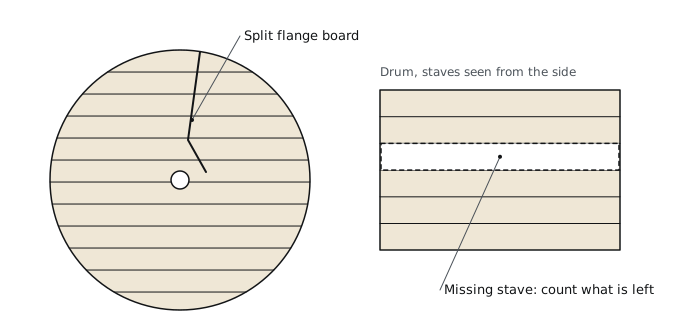
A reel goes to recycling when nobody can safely put cable on it again or build with it. The usual reasons are a split or broken flange, missing or loose staves in the drum, an arbor hole that has been worn oval or split by a reel stand, rot from sitting on wet ground, fire or chemical damage, or a reel that has been cut up on site for blocking. Plastic spools mostly end up here too: they crack, they are sized for particular wire, and few people want them back. In the catalogue, the entries marked Recycles are the types we collect for recycling when they are past reuse.
Recycling is still a pickup. The reels are loaded the same way and taken to the same yard. The difference is what happens next, and whether the collection is free, paid by us or charged. A broken reel has little value in itself, so recycling-only loads are planned to keep costs down: grouped with resale pickups nearby, collected when a truck is in the area anyway, or combined into one trip at the end of a project.
What a wooden reel is made of
Taking a reel apart shows why most of it can be recycled. A nailed wood reel is mostly boards: two flanges, each built from two layers of boards nailed crosswise, and a drum of narrow staves. Heavy reels add steel: tie rods that run between the flanges, nuts and washers, and an arbor plate bolted over the centre hole. There are hundreds of nails in a big reel. Lagging boards, the slats nailed across the rims to protect the cable in transit, are more wood. Plywood spools are plywood discs and a fibreboard tube. Plastic spools are one or two moulded plastics. Each part has a different route, explained on where recycled reels go.
What we do not take for recycling
- Returnable reels. A broken returnable reel still belongs to its maker, and makers have their own rules for damaged reels. We tell you whose it is.
- Reels with cable still on them, unless agreed beforehand. The cable is someone's property and is handled separately.
- Wood contaminated with oil, tar or chemicals. It cannot go to mulch or biomass. Mention it, and we will say whether it can be handled.
- General site waste. Pallets, drywall offcuts and packaging are not reels; a skip hire firm is the right call for those.
Recycling pages
- Broken reels: what counts as broken, what can be fixed and what cannot.
- Where recycled reels go: the route for wood, steel, plywood and plastic.
- Clearing reels off a job site: end-of-project clear-outs of mixed good and bad reels.
Why not just use a dumpster
Whole reels are mostly air. A 48-inch reel takes up a lot of a dumpster and costs the same to haul as dense waste of the same volume, while adding almost nothing to its weight. Waste haulers often charge extra for bulky wood or refuse to take reels at all. Reels collected separately cost less to move, and most of the material in them gets used again rather than buried. On projects that report how much waste was diverted from landfill, a separate reel collection is also an easy number to record.
Mixed loads are the normal case
Few piles are all good or all broken. A typical end-of-job heap has a few clean reels worth reselling, a few that need a stave replaced, a couple that have been run over by a loader, and some plastic spools. One request covers all of it. The reply sorts the list into groups and says what happens to each, and the driver confirms the sort as the reels are loaded. You do not need to separate them beforehand, except for returnable reels, which should be kept apart so nobody loads them by mistake.
Recycling across both banks
Recycling pickups cover the same eight counties as resale pickups: Philadelphia, Bucks, Montgomery, Chester and Delaware on the Pennsylvania side, Camden, Gloucester and Burlington in New Jersey. A truck that has crossed the Commodore Barry Bridge for a resale load in Logan Township can bring broken reels back from Paulsboro or West Deptford on the same trip, which is the kind of routing that keeps recycling-only pickups affordable. Requests from neighbouring counties are welcome when they make sense on a route.
Partners downstream
Wood goes to processors that grind it for mulch, animal bedding, landscaping or fuel; steel goes to scrap yards.
Feedstock for other products
Clean ground wood also becomes compost bulking agent, particleboard feedstock and biomass boiler fuel.
Nails, staples and magnets
Grinders use magnets to pull fasteners out of chipped wood, sending them on as scrap.
Questions
Is recycling free?
Sometimes. If recycling-only reels come with resale reels or sit near other pickups, collection is usually free. A large, isolated load of broken wood may carry a charge, and the reply states it before anything is booked.
Can you take lagging boards and offcuts from the reels?
Yes, if they are stacked with the reels. They go with the reel wood.
What about burnt reels?
Burnt or charred reels cannot go to mulch. Say so in the request.
Last reviewed 2026-11-09.