A size class with two personalities
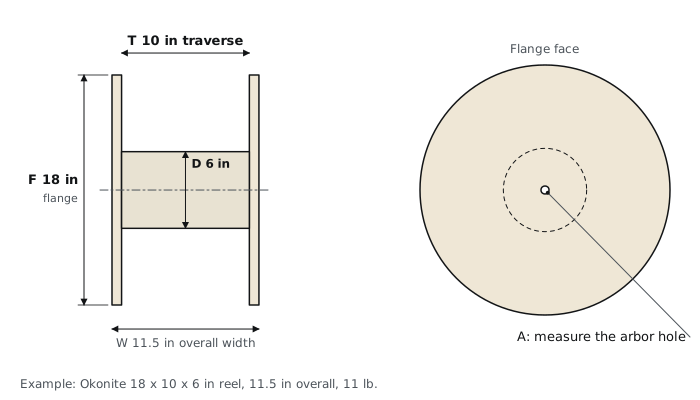
The 18-inch class runs from about 15 inches to 19 inches across, and it includes two quite different reels. One is the narrow plywood spool with a 2-inch arbor hole, like Southwire's G-2.333 at 15¾ x 13¼ x 5 inches. The other is a small but proper reel with a 3⅛-inch arbor hole and a stave drum, like Southwire's N-1 at 15¾ x 7 x 8 inches and its wider sibling the N-2 at 15¾ x 14 x 8 inches. Okonite's 18 x 10 x 6 wood reel sits between them, at 11½ inches overall width and 11 pounds. The difference matters: the reel type decides what stand fits it and how much load it takes.
Measuring to confirm the class
Measure flange diameter edge to edge. Then measure the arbor hole: about 2 inches means a light spool, about 3 inches means a reel built for a standard reel stand. Next measure the traverse between the flanges. A 7-inch traverse on a 15¾-inch flange gives a squat reel; a 13- or 14-inch traverse gives one nearly as wide as it is tall. Weights are small either way, from about 5 to 11 pounds empty.
Who uses this size
Distributors ship cut lengths of building wire, small feeders and control cable on 18-inch reels, and contractors carry them onto jobs by hand. Compartment reels also start around this size, with two or three short compartments for conductors that are pulled together. Fibre drop cable for homes and small businesses sometimes ships on reels of this class too.
Condition points
At this size the weak spots are the drum and the arbor hole. Fibreboard tubes crush when something heavy is stacked on them. Stave drums on the N-type reels loosen if the reel has been wet and dried again. The arbor hole on the small plywood spools is close to the edge of the tube and splits if the spool has been forced onto a thick bar. Check those three things before counting a reel as reusable.
Uses after the job
- Bar stools and side tables, using the 15¾-inch plywood flange as a seat or top.
- Hose reels for a balcony or small garden, on a 1½- or 3-inch pipe depending on the arbor hole.
- Fence reels for polywire and polytape.
- Workshop reels for rope, chain and extension cords.
- Compartment reels for two kinds of wire or tape side by side.
Selling a stack
Like the 12-inch class, these are collected in numbers. A stack of ten or more clean 18-inch reels at a contractor's shop is a sensible stop, especially when a truck is already working in the same county. Keep them dry and away from vehicle traffic in the yard; the light flanges crack under a tyre.
How they ride on a truck
18-inch reels are hand-loaded. They stack on their flanges in columns, and a van or the cab end of a box truck holds a lot of them. That makes them cheap to collect alongside bigger reels, and one reason a mixed list is always welcome.
The 15¾-inch plywood flange is roughly the diameter of a stool seat, which makes this class popular for seating. With a traverse of about 14 inches, Southwire's N-2 stands around 15 inches tall on its flange, a good height for a child's table or a low stool. The N-1, with a 7-inch traverse, is too short for seating but makes a sturdy riser or plant stand. Okonite's 18 x 10 x 6, at 11½ inches overall, sits between them. Anyone building furniture from this class should sand the flange edge well, because plywood edges splinter.
In a contractor's shop
Electrical shops in Montgomery and Bucks counties tend to keep 18-inch reels longer than smaller spools, because they are handy for winding up leftover wire for the next small job. When they are finally cleared, they come out in batches of twenty or thirty at once, often with a few compartment reels among them.
Hose, extension cords and the garage wall
An 18-inch spool with a sound drum makes a good hand-wound reel for a garden hose, an extension cord or a length of rope. Mount it on a short steel pipe through the arbor hole, fix the pipe to brackets on a wall or a sawhorse, and wind by turning the flange. Hobby farmers use the same trick for electric fence polywire and tape. For that use, a smooth drum matters more than a perfect flange, and plywood spools work as well as timber ones. Neighbours often borrow the idea once they see it, so keep a spare.
Shelving and display
Stacked with boards between them, 18-inch spools make sturdy low shelving for record collections, books or shop displays. Pick spools of the same overall width so the shelves sit level.
Questions
What is the difference between a spool and a reel at this size?
Mostly the arbor hole and drum. People use the words loosely; we call the light 2-inch-hole ones spools and the stave-drum 3⅛-inch-hole ones reels.
Will an 18-inch reel fit on a standard cable stand?
The N-type reels with a 3⅛-inch hole will. The G-type spools with a 2-inch hole need a smaller bar.
Last reviewed 2026-11-09.