
Guide
Choosing a spool for a table
Pick a large wooden spool for a table: flange size for the top, traverse for the height, sound staves, and how to clean off stencils and lagging nails.
Start with the height
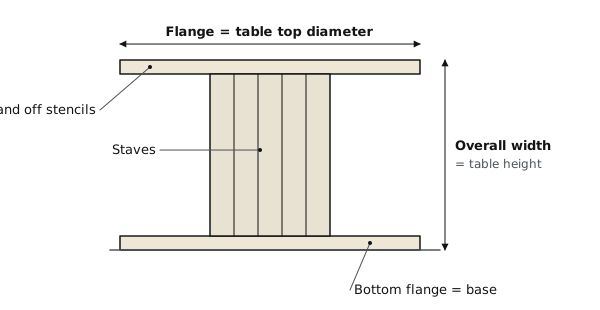
The single most important number for a spool table is its height, and on a reel standing on one flange, height equals the reel's overall width: the traverse plus both flange thicknesses. Cable makers publish this for their reels, which makes choosing easier than guessing. Common furniture heights:
- Coffee table: about 16 to 19 inches.
- Side table: about 20 to 25 inches.
- Dining table: about 28 to 30 inches.
- Bar or counter table: about 36 to 42 inches.
And some published reels that fit:
| Use | Reel | Overall width (height) | Source |
|---|---|---|---|
| Coffee table | Okonite 24 x 12 x 10 | 15 in | Okonite |
| Side table | Okonite 24 x 18 x 10 | 21 in | Okonite |
| Side table | Southwire N-7P, 23¾ x 22 x 12 | 25 in | Southwire |
| Small dining | Southwire A-10, 30 x 22 x 16 | 25 in | Southwire |
| Dining | Okonite 36 x 24 x 17 | 28½ in | Okonite |
| Dining for four | Southwire A-29, 42 x 28 x 21 | 32 in | Southwire |
| Bar table | Okonite 72 x 36 x 36 | 41½ in | Okonite |
A table a little low can be raised with feet or casters; one too high cannot easily be lowered.
Then the top diameter
The flange becomes the top. A 24-inch top suits a lamp and a book; 30 to 36 inches seats two for a meal; 42 to 48 inches seats four. Bigger than that, the reel is too heavy to move once placed and too big for most rooms. Remember the bottom flange is the same size as the top: a 48-inch reel needs a 48-inch circle of floor.
Then the build
Plywood flanges give a smooth top quickly. Nailed board flanges give a plank top and more work. Outdoors, nailed boards last longer. The plywood vs nailed guide compares them in detail.
What to check on the reel
- Stand it on each flange. It should not rock. A rocking reel has a warped flange or a twisted drum.
- Roll it. A click or a wobble means a loose stave.
- Look at the top face. Deep splits, missing knots and big gaps are work; surface weathering is not.
- Look at the drum. Every stave present. The drum carries every plate and elbow put on the table.
- Check for paint and treatment. For indoor or food use, choose plain wood.
- Look for writing. A heavy stencil on the top face takes a lot of sanding to remove. A stencil saying RETURNABLE means the reel is not for sale at all.
The arbor hole is a feature
The centre hole on most wood reels is 3⅛ inches, which happens to take a standard patio umbrella pole. On an indoor table, plug it with a dowel or a turned wooden plug, or fit a glass top over it. Some makers run a lamp cable up through the drum and out of the hole.
Getting it home
Measure doorways and turns before choosing a size. A 36-inch reel goes through most exterior doors on its rim, straight on. A 42-inch reel often will not. Reels of 48 inches and up live outdoors or in garages with full-height doors. Weight matters too: published examples run from about 20 pounds for a 24-inch plywood reel to over 150 pounds for a 42-inch nailed reel.
Finishing, briefly
Pull every protruding nail and staple. Replace or reglue any loose staves. Sand the top, coarse then fine. Fill gaps with wood filler or pour epoxy for a glassy surface. Seal with a finish suited to indoor or outdoor use. Add felt pads, feet or locking casters to the bottom flange.
How to ask for one
Choose Buy reels on the request form and give the height, the top diameter, plywood or plank, indoor or outdoor, and your ZIP code. The reply lists matching reels with their real measurements.
Matching the room
A heavy timber reel with grey, weathered boards suits a rustic porch, a barn wedding or an industrial-style loft. A clean plywood reel, sanded pale, suits a Scandinavian living room, a children's playroom or a minimalist office. Dark stains and wax suit libraries and dens. Paint suits nurseries and classrooms, where colour matters more than grain. Think about the floor too: on hardwood or tile, felt pads or rubber feet prevent scratches; on carpet, casters roll better than flat flanges. On decks, lift the bottom flange slightly off the boards so water drains away rather than pooling under it.
Seating around it
Most reel tables sit lower than a dining table, so pair them with low chairs, floor cushions, benches or smaller spools as stools.
Budget, time and tools
Turning a raw reel into furniture takes an afternoon or a weekend: a wire brush, an orbital sander with coarse and fine discs, a pry bar, pliers, a hammer, wood filler, and a finish. Hiring a joiner or furniture restorer makes sense for heirloom pieces.
Questions
What size spool makes a good coffee table?
A 24-inch reel with a traverse of about 12 inches, giving a height near 15 to 16 inches.
Are spool tables stable?
Very, once the drum is tight. The wide bottom flange makes them hard to tip.
Can a spool table go outside year-round?
A sealed nailed reel stood off the ground on feet lasts several seasons. Plywood does not.
Last reviewed 2026-11-09.