The largest reels in the catalogue
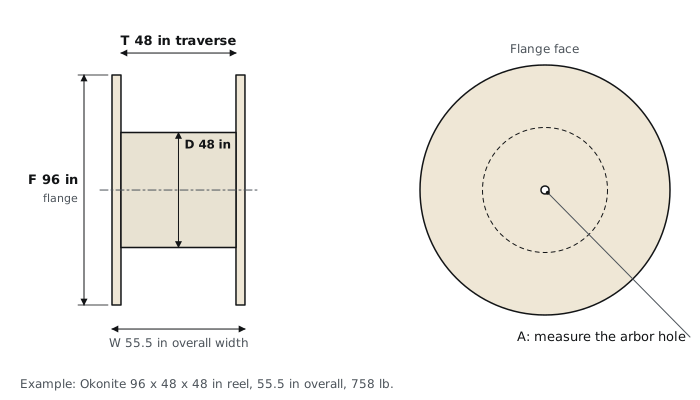
Ninety-six inches is eight feet across, and the reels in this class are the biggest that turn up empty in the Delaware Valley with any regularity. Okonite uses one as its example when it explains reel designations, writing a reel's size as Flange x Inside Traverse x Drum, for instance 96 x 48 x 56. Its published table lists a 96 x 48 x 48 wood reel at 55½ inches overall and 758 pounds, and a 96 x 54 x 56 at 61½ inches and 816 pounds. Prysmian's 96-inch wood reel, 96 x 48 x 42 inches and 54 inches overall, weighs 1,150 pounds. Southwire's S-300 steel reel, designated RMT 96.60 and marked returnable, is 96 x 60 x 42 inches with a 5¼-inch arbor hole and 1,082 pounds.
Moving a reel this size
An empty 96-inch reel can weigh more than half a ton. It needs a forklift rated for that weight at a long load centre, a crane, or a purpose-built reel trailer. Sonoco's truck table puts only eight reels of 96 x 60 x 42 on one truck. Loading is slow and careful work: each reel is lifted under the drum, set on its rims on the bed, chocked and strapped. On site, the reel should sit on firm, level ground, chocked on both sides, with a clear zone around it.
Wood, steel and ownership
At this size, steel reels are common and wooden reels are often built with tie rods and steel arbor plates. Look at every reel before counting it:
- welded steel flanges: returnable to the maker;
- wood with a maker's stencil or a reel number: possibly returnable, check;
- plain wood with tie rods and arbor plates: usually a one-way heavy wooden reel.
Where they come from
The 96-inch class carries the heaviest cable used in this market: high- and medium-voltage utility cable, large substation feeders, and cable for big industrial and data-centre power systems. Reels this size appear in utility laydown yards, at substation construction sites, and at the largest building sites, where they may sit for months between pulls.
Reuse and recycling
Very few people can reuse a 96-inch reel as a reel; those who can are heavy-cable contractors and rewinders, and they want sound reels in matched sets. A damaged 96-inch wooden reel yields a lot of material: heavy flange boards that are often long enough to reuse as timber, thick staves, tie rods, nuts, washers and arbor plates. Collection is planned around equipment and route, and a request should say what lifting equipment is on site.
As a feature piece
Now and then someone wants a 96-inch reel as a garden feature or a stage set. It can be done, with a machine to place it and firm ground under it. Expect the reel to need some repair and a lot of nail pulling first.
Planning a 96-inch pickup
A request for a 96-inch reel should say where it is standing, what is under it (concrete, gravel, soil), how close a truck can get, what lifting equipment the site has, and whether there are overhead lines or structures near the reel. Those details decide whether the pickup needs a forklift rated for heavy loads, a crane or a reel trailer, and whether it can happen at all without preparing the ground. Expect a site look or detailed photographs before a date is set.
Steel examples and arbor bushings
Southwire's S-300, with a 5¼-inch arbor bushing, shows how much bigger the shaft on a heavy reel stand is than on the 3⅛-inch wooden reels lower in the table. That difference is one quick way to identify a steel reel from a distance.
Eight feet: the practical ceiling
Eight-foot reels are close to the largest that travel easily on public roads. Larger drums exist for submarine and transmission cable, but they move on special trailers or by barge, and they rarely become surplus in a city yard. Lying flat, a 96-inch reel takes nearly the full width of a standard trailer deck; stood upright on a flatbed, it approaches legal height limits. Loads this size are therefore planned trailer by trailer, often on a step-deck or lowboy, chained through the arbor hole, with clearances checked against every bridge on the route.
Who keeps reels this size
Utilities, cable makers and specialist contractors own most 96-inch reels and expect them back. Truly surplus ones are uncommon. When one does turn up, it is often a one-way timber reel from a substation or a large feeder job, and its best future is usually as heavy timber for another project, a feature piece, or recycling.
Paperwork and ownership checks
Expect maker stencils, serial plates and deposit tags at this scale; record them all before anything moves.
Questions
How tall is a 96-inch reel lying on its side?
Its overall width: about 54 to 68 inches, depending on the traverse, going by the published examples.
Do you collect 96-inch steel reels?
No. Steel reels belong to their makers. We tell you whose it is so it can go back.
Last reviewed 2026-11-09.